Showing posts with label Likes. Show all posts

Sunday, 9 June 2013

11 Things You Need to Immediately Stop Doing on Facebook

Are you getting tired of Facebook or some of the behavior of your friends on the site? Facebook is the most popular social network with over 1 billion active users. And with great popularity comes some shameful characters looking to tap into Facebook’s viral market to sell you their crappy products or scheme your money through affiliate links or worse.
So if you happen to find yourself doing any of the 11 following things, you should look to stop doing so immediately before all of your friends look to jump ship!


1. Tagging Random People in Photos
2. Cross-Posting From Twitter
3. Liking Your Own Posts
4. New Page Invites
5. App Requests
6. Suggesting Friends
7. Adding People to Random Groups
8. Off-base and Mass Messages
9. The Ridiculous Event Invite
10. Overdone Like Buttons
11. Poking People

Please stop tagging people you barely know in photos that have nothing to do with them. It’s one thing when your buddy tags you in an unphotogenic pic, then sends it out to friends for some laughs, because, hey, at least it’s you. But the people I’m talking about upload photos and tag as many people as they can to try and gin up as many likes as possible. This is a classic move by spammers so be cautious of anyone who does this. I’ve had to call out several individuals over the years, even friends for their random tagging, and you should do the same in any suspect post. Sending a personal message to them to stop could work, too, but I feel like if some goofball wants to tag me in every one of his posts, he must be looking for my input so I give it to him publicly right then and there. Yes, revenge is a dish best served cold…
Look, I understand you’re a little short on content and things to say. We all basically post the same stuff on Twitter, Facebook, Google+, etc. but at least have the decency to not automatically send your Twitter tweets to Facebook. For one, you’ll get much less engagement posting to Facebook via any third-party app let alone Twitter which basically disregards Facebook etiquette. If you do this, it’s a clear sign you’re not really engaged on Facebook or maybe just too lazy to post yourself, either way a fail.


11 Things You Need to Immediately Stop Doing on Facebook image FACEBOOK FAIL by Chibi Yuri

So you’ve just posted the cutest cat or baby picture ever. That’s cool, I guess. But then you go ahead and like your photo too. Well, I know you already like the post, aren’t you the one who just shared the damn thing? Besides being annoyingly repetitive, the real reason people feel the need to do this is that the action of liking the post will again show up in the streaming news ticker, giving the post even more exposure (it’s potentially seen twice). These are typically the moves of self-proclaimed “social media gurus” or people who just feel insecure about their status posts.
Look, I understand you need to create a page for your business, but please stop inviting me to your half-ass Facebook pages. Instead post interesting content to your own page, share it on your profile as well (so your friends see it), and if people find it interesting they will follow. It’s almost not your fault, as creating a page and inviting all your friends can be tempting, but most of your friends won’t like your page and maybe they won’t like you anymore either. And the ones who do like it would’ve probably found it anyways without your begging them to do so. So don’t do this…


11 Things You Need to Immediately Stop Doing on Facebook image message
11 Things You Need to Immediately Stop Doing on Facebook image what you really sound like on Facebook

If you’re on Facebook all day playing Farmville, that should be embarrassing enough, and the last thing you should ever want to do is invite your friends and alert them to your nerdiness. And I can’t even explain to you the ill feeling I get when I receive a request to join Klout, for example, even though I’ve already registered, from one of my less intelligent friends.
Please stop suggesting I friend somebody else. You playing match-maker is a little creepy and I might start to question why you and I are friends instead. And it’s actually worse than creepy because, you see, on Facebook expert spammers pair up and start suggesting up to 50 random friends for each other. By doing this, the people they suggest will get the notification (in their friend requests) and may mistakenly think the spammers requested the friendship. In reality, the spammers want you to commit the first step by adding them as friends (essentially tricking you to friend request them). Facebook penalizes people for requesting too many friends, but spammers who pair up and suggest friends for each other escape notice since they are not actually doing the requesting.
This one’s a big pet peeve of mine. A classic text-book spam artist move, people will add you to random groups without your knowledge and all of a sudden you’re signed up for every single notification for each posts to the group. If this happens to you, make sure to leave the group or at least turn off the notifications within the group settings, as well as question the friendship with the culprit who added you. You don’t want to be the person known for doing this on Facebook, it’s a huge red flag.
Stop sending mass messages with dozens of people attached. You’ve seen these before, like “please like my page” or “vote for me in this ridiculous award I can’t win,” etc. People loathe being addressed in this style, and if you really have something to say at the very least personalize your message to each individual or, better yet, refrain altogether from sending out mass messages. After all, it’s straight out of the guide to spamming.


11 Things You Need to Immediately Stop Doing on Facebook image please vote
11 Things You Need to Immediately Stop Doing on Facebook image what really happens on Facebook


I’m honored you want me to come to your poetry reading in Siberia, but I’m not quite sure I’ll be able to make it. When you send mass requests to a bunch of people you don’t really know, it makes you seem inconsiderate and pretty much paints you as a spammer.
Somehow I’ve ventured over to your blog only to be greeted by an alarming pop-up Facebook “like” box baiting me to like your page. And then, when that goes away, I can barely even see your blog post because of the 100 “like” buttons strategically placed throughout your site.


11 Things You Need to Immediately Stop Doing on Facebook image too many like buttons

Always sort of a joke, it might be time to finally retire this Facebook feature. Something just feels off every time you poke me. No matter how you cut it, there isn’t a single situation in which poking someone is acceptable.


11 Things You Need to Immediately Stop Doing on Facebook image poke me again i dare you
If you are one of the millions of people committing these crimes on a daily basis, please refrain from doing so at once! You know who you are. I promise you whatever you’re trying to sell or market will have a much better chance if you come up with some honest hard-working tactics like creating or curating interesting and relevant content as opposed to relative social media douchebaggery.
11 Things You Need to Immediately Stop Doing on Facebook image get more likes
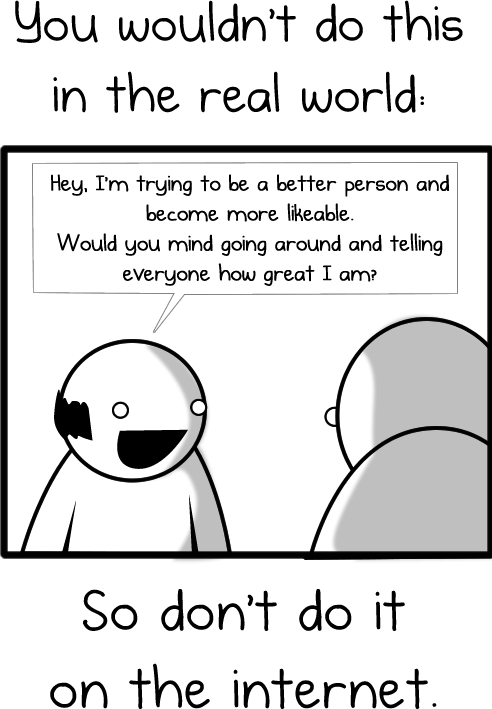
11 Things You Need to Immediately Stop Doing on Facebook image you wouldnt do this in the real world
11 Things You Need to Immediately Stop Doing on Facebook image create awesome things 685x1292

It’s that simple folks, avoid these 11 things and one day you can go from a spam-bot back to being my friend! Does anything else annoy you about Facebook?


Wednesday, 17 October 2012

Making Money Using Facebook - Internet Marketing

We Internet Marketers are always researching the most profitable ways to make money online and promoting our business to targeted people. Facebook is the most powerful social media system that we can use today, totally free, so why not use it in our advantage to promote our business?
So... How do we make money online using Facebook?
Interesting question, Facebook can be treated as a direct portal that will drive targeted visitors into your webpages, where you promote a product or where you just want to get more people signing up into your lists. Facebook CAN do that in a very powerful way... let me introduce you the Facebook PAGES!
What is a Facebook Page? It's just like your personal profile, but will be treated as a stand-alone "Profile" where you can promote your business. You won't have any "Friends" in a Facebook Page, instead you will have "LIKES", and those Likes will come from people visiting your Page and finding the content interesting for them.
What is the Power of this, you might be asking? When someone Likes your Page, he will start receiving on HIS wall all the comments and updates that you make into your PAGE. So with a single comment you can reach hundreds and hundreds of people.
Just imagine you have a Page with 100 Likes, 100 persons that are connected to your business, regularly checking your updates. When you post something new, this post will get posted on all those person's Walls. And what can happen next? EVERY friend of those persons might be watching his Wall, and they WILL notice your post as well!
Are you beginning to see the power of this? a single post can go VIRAL very easily!
But please notice that it is not that easy to achieve this task. As any real and well planned Internet Marketing strategy, you have to invest time and effort to build a good-looking Page with good content, that attracts people's attention. If you are serious in this business, you will find Facebook as a fantastic source to promote your business.
Now let's discuss how to get Likes...
First of all, you need to know right away that this process takes time, you won't get 1000 Likes from one day to another.
You can buy traffic you might think, let me tell you that I tested this myself and it didn't work. I bought 1000 Likes to my Fan Page and I found that all those people were unresponsive, but unresponsive at all.
So, my best advice to you is to just work on it by yourself, and be patient.
Let's review some quick TIPS about how you can promote your Fan Page to the Facebook community:
  1. Recommend your Fan Page to your friends, using your main Profile. And tell them to spread the word. This maybe is the fastest way to get some activity into your Fan Page, but it will only depend on how much friends you have and how cool they might be to help you out.
  2. Join related Fan Pages. Just search for them, find those that have daily activity, both from the owner of the page and from people posting comments on it. Like those Pages and post comments on them. But beware, please DO NOT make spam promotion because it is very annoying, just add some value into your posts, share with the community links, videos, some articles made by you maybe, and I assure you that people will notice your Fan Page when they see you contribute good things to them.
  3. Make Posts in your Fan Page regularly. Same as point 2, but with your Fan Page. Dedicate no more than half an hour a day doing this, just seek for some valuable content that people might see helpful, and share! If you have an active website with good content, you will already have LOTS of information to share in your Fan Page. Same applies with videos, articles that you might already have.

After you get some people Liking your Fan Page, you will start generating automatic traffic each time you post a comment on your Wall. Those people will have your post commented on their wall, and their friends will notice it as well. Viral Traffic for free!

Wednesday, 5 September 2012

Facebook's and Twitter's Dirty Little Secret

Information recently revealed from a variety of sources suggests that a huge percentage of users on social sites like Facebookand Twitter aren’t actually human.Millions upon millions of
social accounts are either created by “bots” or have been created for some other
purpose than social networking.And I believe the problem is much worse than is being reported.
The Trouble With Facebook and Twitter
In a company filing earlier this month, Facebook reported that 83 million Facebook accounts are fake users. A social media management company called Status People created an online tool called Fakers,
which estimates the relative percentages of anyone’s Twitter following that’s fake, inactive and good.
For example, Twitter’s number-one user, Lady Gaga, supposedly has about 30 million followers. But Fakers says 71% of those little monsters are either fake or inactive. In reality, Twitter’s
number-one user has fewer than 9 million actual followers, if Fakers is accurate.
Personally, I doubt the real number of fake Facebook and Twitter accounts are actually that low. The reason is that in neither case are the methodologies used to reach these numbers transparent. And I think it’s nearly impossible to detect a well-managed fake account.
I’m certain that I could create a fake Facebook or Twitter account, visit it weekly for ten minutes of activity, and no bot or machine or survey could ever determine that it’s a fake account.
In former Defense Secretary Donald Rumsfeld’s lingo, detection software can identify only the “known unknowns” and is clueless and powerless in the face of the “unknown unknowns.”
I think the percentages listed above are minimums, and that actual percentages of fake accounts is much higher.

The Fake User Industrial Complex
Where do fake user accounts come from? They come from many sources and serve many purposes. Here are some of the major sources for fake user accounts.

Fake user market: At least 58 companies currently appear online to sell fake users. Pay one of these services less than $20, and your Twitter following will go up by 1,000 users in 24 hours. A million new fake followers will cost you more than $1,300 and take a few days. You can also buy followers for Facebook, YouTube, Instagram and others.

Spammers: People hoping to sell something also create fake user accounts in large numbers.

Trolls: Most online trolls have multiple fake accounts, which they use to mess with people.

Astroturfers: Anyone who wants to fake a grass-roots
campaign of some kind can higher low-cost workers to create very large numbers
of fake accounts, which they can then use to leave opinion comments, creating
the illusion that an idea is more popular than it appears. Many politicians in the US and
in other democracies are almost certainly doing this, too. For example, Barracuda Labs reported
that within a period of 24 hours during the month of June, the Twitter followers
of presidential candidate Mitt Romney grew by 116,992. Here’s the kicker: One
quarter of those “users” had joined Twitter within the prior four days.

Regular people with multiple accounts: Some “fake” accounts are merely created for a variety of purposes. I personally have created about a dozen Twitter accounts over the years for various projects. I never closed any of them.

Abandoned accounts: A huge number of social media
accounts are created, then abandoned. They’re not “fake” users, but nobody’s
home. A user is only a user if he uses.

Developers: Developers often create multiple fake
social media accounts so they can test an app or some other project.

Criminals: Identity thieves, drug dealers, terrorists -- you name it. It’s not very smart to coordinate or execute various law-breaking activities from a real social media account. It’s easy enough to just create a new fake one, and use that from a public terminal.

Social Network Founders: Reddit founder Steve Huffman admitted in an online computer science class that Reddit was launched with a large number of fake users. The two founders wrote a capability available only to them
whereby adding a user name automatically registered that username as a real
user. For the first few months, Reddit appeared to have hundreds or thousands of users, but they were mostly just the two founders. This is probably pretty common, especially for apps that interface with social networks (as many now do).

The Fake 'Like' Industry
BBC reporter Rory Cellan-Jones tested the
value to businesses of Facebook advertising and “Likes.” He created a fake company called VirtualBagel, which offered a bogus service: downloadable electronic bagels.
He bought $60 worth of Facebook advertising, and got 3,000 “Likes.”
Upon closer inspection, however, he found that many of the “Likes” were made by fake accounts, and by serial “Likers” -- for example, one fake account in Egypt that had also “Liked” 3,000 other brands.
He also noticed a wildly disproportionate number of “Likes” coming from certain countries -- Egypt, Indonesia and the Philippines. A bioscience consulting company called Comprendia discovered something similar. Some 54% of “Likes” for their a company came from India,
Mexico, Indonesia, and Portugal, which collectively represent only 15% of
Facebook users. They estimate that about 40% of the Facebook “Likes” they got
were from fake accounts. Facebook recently announced
a new initiative to automatically remove fake “Likes,” which it says come from
“malware, compromised accounts, deceived users, or purchased bulk likes.”
But this program appears to me to be more of a PR stunt than an effective elimination of fake “Likes.” For starters, Facebook estimates that “on average, less than 1% of Likes on any
given Page will be removed.” However, the actual percentage of fake “Likes” is
surely much higher, possibly as high as 40%, as Comprendia estimates.

The Fake User Problem
I believe the fake social user
account problem is going to become a far bigger challenge than most people believe.
It’s an arms race, comparable to the contest between email spammers and spam filter companies. As companies find new ways to detect and close fake accounts, the fakers will find new ways
to open undetectable ones.Fake accounts will increasingly
sway public opinion, spam social streams with sophisticated and hard-to-detect
soft pitches for products and services, socially engineer people for criminal
purposes and much more. The fake social user account
problem will be devastating for Facebook and Twitter, which will have to work
hard to convince advertisers that users and “Likes” and tweets are living,
breathing human beings, and not bots or scammers.